Carista OBD2 Car Scanner
- 3.9
- Rating
- 1.00M
- Installs
- Free
- Price

 Analysis by App-foxy
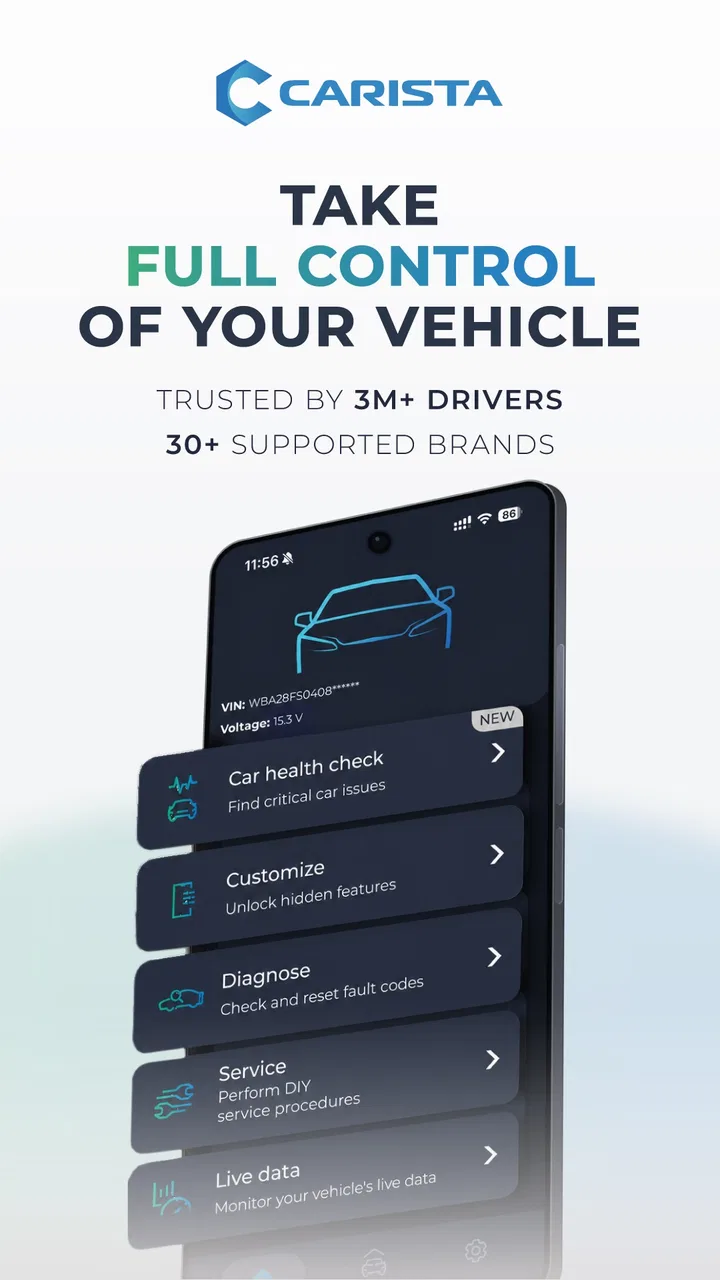
I like car apps that solve a specific problem without pretending to replace a trained mechanic. Carista OBD2 sits in that useful middle ground: it turns a compatible OBD2 adapter and an iPhone or Android device into a practical dashboard for checking fault codes, viewing live vehicle information, changing selected settings, and keeping up with routine service tasks. I found it most valuable as a way to understand what a warning light may be telling me before deciding what to do next.
It is a free Auto & Vehicles app from Prizmos Ltd., rated for Everyone. The app has built a sizable audience, with more than a million installs and an average score of 3.7 from roughly nineteen thousand ratings. That combination tells me two things: plenty of drivers find it useful, but the experience is not universally smooth. The reason is that Carista depends heavily on the vehicle, adapter, phone, and the exact function being requested.
How Carista OBD2 feels in everyday use
In a shared household, I’d treat Carista as a tool for a particular car, not as a shared account or a complete service record. This section looks at how the app fits when more than one person may check a warning or adjust a setting, and why agreeing on a simple handoff can prevent confusion. The next part focuses on keeping setup and changes deliberate.
You May Also Like

 Blood Strike: 2.5 Anniversary
Blood Strike’s Loadouts Turn Every Drop Into a Tactical Gamble
A close look at Blood Strike’s custom loadouts: how fast access to signature weapons reshapes its battle royale rhythm, rewards preparation, and narrows the gap between fights.

 Pandora - Music & Podcasts
Pandora’s Music Is Easy to Start, but Harder to Recover
Pandora’s strength is its low-effort path from a seed to a station. Its weak spot is how much confidence it asks you to place in connection, setup, and quiet recovery.

 8 Ball Pool
 Is Built on Rivalries, Rematches, and Routine
A close look at the rivalries, rematches, shared routines, and unanswered safety questions that turn a quick pool match into a persistent mobile community.

 Samsung Music
’s Quiet Strength Is Playing What You Already Own
Its reach comes less from spectacle than from dependable access to a personal library. That simplicity is both the app’s strongest retention engine and its ceiling.

 AccuWeather: Weather Radar
AccuWeather Review: A Quick, Clear Forecast for Everyday Decisions
For everyday plans, the best forecast is the one you can understand quickly. AccuWeather makes rain timing, radar, and local conditions easy to act on, with a few trade-offs.

 Hill Climb Racing
Why Hill Climb Racing Still Turns Crashes Into One More Run
A tiny car, a bumpy hill and one more upgrade: Hill Climb Racing keeps resurfacing because its simple chaos makes every near-miss feel personal.
More From Our News Desk



A practical starting point for a warning light
The clearest use case is a dashboard warning that appears at an inconvenient time. Instead of immediately guessing whether the issue is serious or booking a diagnostic appointment without any context, I can connect a compatible adapter, open the app, and scan the car. Reading a fault code does not fix the underlying problem, but it gives me a starting point for a conversation with a garage and helps me avoid treating every warning as an emergency.
The important distinction is between reading a code and diagnosing a fault. A code usually identifies a system or condition, not a single failed part. For example, an emissions-related code can have several possible causes. I would use the result to decide whether to stop driving, arrange service soon, or investigate further—not as permission to ignore a warning or replace parts blindly.
The live-data screens are also useful when a fault is intermittent. A static code tells me that the vehicle detected something; live readings can help show what the car is doing while it is running. I found this more useful when checking a symptom that changes with temperature, engine load, or driving conditions. It is less helpful if I expect the app to interpret every value automatically and deliver a definitive repair plan.
Customization is where vehicle compatibility matters most
Carista can expose customization options that are otherwise hidden behind manufacturer equipment or a specialist workshop tool. Depending on the vehicle, that may mean changing convenience behavior or adjusting selected factory settings. This is one of the app’s more interesting strengths because it can save a trip to a dealer for a small preference change.
It is also the area where I would be most cautious. The available options are not identical across brands, models, trim levels, and control modules. A feature that appears in a video or forum post may not appear in my own car. Even when a setting is available, I would record the original value before changing it and alter one item at a time. That makes it much easier to reverse a change if the result is unexpected.
I would not use customization as a casual experiment on a car I depend on every day. The app makes access more convenient, but convenience does not remove the risk of changing a setting I do not fully understand. For careful owners who want a specific adjustment, it can be worthwhile. For anyone who simply wants to explore every menu, a professional technician is the safer choice.
Service information is helpful, but it is not a workshop
The service-related tools make the app more useful after routine maintenance. If I have carried out an appropriate service and the vehicle supports the relevant reset, I can use the app to update the car’s service status rather than leaving a reminder active. That is convenient for drivers who maintain their own vehicle or use an independent garage.
There is a crucial workflow here: complete the mechanical work first, then reset the electronic reminder. Resetting an interval without changing the oil, filters, or other required items only hides the prompt. I see Carista as a record-and-reset companion, not as a substitute for the maintenance schedule in the vehicle handbook.
The same principle applies to fault-code clearing. Clearing a code can be useful after a repair, but clearing it before understanding the cause can erase helpful evidence. I prefer to scan first, save or note the result, inspect the likely issue, and only then clear the code if the problem has genuinely been addressed.
What the current release says about the product
The current version is 9.7.2, and the app has been available since April 8, 2013. That long presence matters because this is not a brand-new experiment; it has had time to develop around the practical needs of vehicle owners. I see the current release as part of an established diagnostic and customization tool rather than a simple code-reader screen.
At the same time, a version number alone does not guarantee that every vehicle-specific function will behave the same way. Car software is unusually dependent on hardware and manufacturer implementation. A newer app can improve the interface or support more situations while still being limited by what a particular control module allows.
The minimum operating-system requirement is iOS 9 or later. That makes the app accessible to owners using older Apple devices, although compatibility with the phone is only one part of the setup. The adapter, vehicle, connection method, and supported functions all matter just as much.
My recommended first-session workflow
I would prepare before plugging anything in. First, I would identify the exact vehicle year, model, engine, and trim. Then I would use a compatible adapter, park safely, switch off unnecessary electrical loads, and keep the phone close enough to maintain a stable connection. A loose adapter or interrupted session can create needless confusion.
Connect the adapter while the vehicle is safely parked.
Open the app and allow it to identify or connect to the vehicle.
Run a scan before changing settings or clearing anything.
Write down fault codes and take note of the conditions around the warning.
Check the available live data only after understanding what each value represents.
Make one customization change at a time, if the option is supported.
Scan again after a repair or setting change to confirm the result.
This order prevents one of the most common mistakes with diagnostic apps: changing several things and then having no clear idea which action caused the new behavior. It also creates a useful record for a mechanic if professional help becomes necessary.
Where the free download ends
The app is free to download, but in-app purchases range from $0.99 to $59.99 per item. That pricing structure is important for anyone expecting every tool to be available immediately. I would install it first to check the connection and see what is relevant for my vehicle, then decide whether a paid function is justified.
I would not pay simply because a menu exists. The value depends on the problem I am trying to solve. Paying for a supported customization that I will use repeatedly can make sense; paying for a diagnostic function that my car does not support is wasted money. The best approach is to identify the exact task first, then consider the purchase rather than treating the app as an all-access replacement for workshop equipment.
For occasional code checks, the cost may be easier to justify than a diagnostic visit, especially when I only need basic information. For complex electrical faults, airbag systems, manufacturer-specific programming, or repairs requiring physical testing, professional equipment remains the better investment. A phone app can communicate with a car, but it cannot inspect a damaged wire, test a mechanical component by hand, or guarantee that a repair is safe.
How it compares with ordinary alternatives
The usual alternative is a small generic OBD2 reader. That device can be convenient for basic engine fault codes, and it may be the better choice for someone who wants a simple, one-purpose tool with no interest in customization. A dedicated reader also avoids relying on a phone connection during a quick roadside check.
Carista becomes more appealing when I want several functions in one place: scanning, live information, selected vehicle personalization, and service-related tasks. Its interface is easier to carry around than a larger workshop scanner, and the phone makes the results more approachable than a tiny hardware display. The trade-off is that the experience depends on the adapter and the vehicle profile, while a generic reader may feel more predictable for a narrow task.
A manufacturer diagnostic system or garage-grade scanner is still stronger for deep module access, guided testing, programming, and difficult faults. I would choose Carista for ownership and maintenance decisions, not for replacing a specialist’s complete diagnostic process. That distinction keeps expectations realistic and is the main reason I think the app works best as a first layer of information.
Who will get the most from it
I would recommend it to a driver who wants to understand a warning light before visiting a garage, an enthusiast who enjoys monitoring vehicle behavior, or an owner who wants to handle supported service reminders and convenience settings personally. It is especially useful for people who are comfortable taking notes, checking the handbook, and researching a code instead of assuming the first result is the final answer.
It can also help someone buying a used car, but only as one part of an inspection. A scan may reveal stored or current faults, yet a clean scan does not prove that the vehicle is mechanically healthy. A seller could have cleared codes recently, and many problems leave clues outside the diagnostic system. I would combine the app with a road test, service records, visual checks, and an independent inspection for an expensive purchase.
I would skip it if I want a guaranteed diagnosis with no learning curve, if I dislike dealing with adapters and connection steps, or if my main need is advanced programming. It is also not the right tool for deciding whether a car is safe to drive when a serious warning appears. In that situation, I would follow the vehicle’s safety guidance and seek qualified assistance.
Small friction points that affect the experience
The 3.7 average rating reflects a product with real usefulness but also real variation. In my view, the biggest source of frustration is not necessarily the core idea; it is the gap between what a driver expects from the app and what the particular vehicle or adapter permits. Two owners can install the same app and see very different results.
Connection problems are another practical concern. Bluetooth or Wi-Fi behavior, adapter quality, phone settings, and the car’s ignition state can all affect a scan. I would avoid cheap, unreliable hardware if I planned to use advanced functions. A failed connection during a harmless scan is annoying; a disrupted customization session is a stronger reason to be careful.
There is also a learning curve around live data. Numbers can look authoritative even when I do not know the normal range for that engine or the conditions under which the reading was taken. I would compare readings over time and alongside symptoms rather than treating a single value as proof of failure.
Privacy and safety deserve common sense, too. I would not operate the app while driving, and I would avoid making changes in traffic or in a place where a connection interruption could distract me. Diagnostic convenience is valuable only when it stays secondary to safe vehicle operation.
What existing users should know about the product’s evolution
For someone who has used an older release, the move to version 9.7.2 is best viewed as part of ongoing maintenance of a mature tool. The app’s long availability and broad install base suggest a product that has continued to serve different kinds of owners, from occasional code readers to people interested in personalization. I would still review the available functions after updating rather than assuming my previous workflow is unchanged.
Existing users should keep their adapter details and vehicle profile information handy when troubleshooting. If a feature disappears or behaves differently, the cause may be compatibility rather than a general failure. Checking the exact car configuration, reconnecting carefully, and testing a basic scan before attempting a more advanced action is a sensible way to separate connection trouble from feature limits.
I would also keep a personal change log. A simple note with the date, setting changed, original value, and result is more useful than relying on memory. This is a particularly valuable habit when using customization menus, because it makes returning to the previous configuration much easier and gives a technician clearer information if something later needs attention.
What I would watch before relying on it
My main watch point is continued compatibility: whether the functions I care about remain available for my exact vehicle and whether the adapter connection stays dependable. I would also pay attention to how clearly the app explains paid features and vehicle-specific limitations. Transparent expectations matter more here than a long feature list.
I would watch the balance between convenience and complexity as well. Adding more capabilities can make an app more powerful, but it can also make it easier for an inexperienced owner to change the wrong setting or misread a code. The best future direction would be clearer guidance around risk, reversibility, and the difference between information and repair.
For current users, the practical advice is simple: update carefully, scan before clearing, change one setting at a time, and keep the vehicle handbook and service records nearby. Those habits make the app safer and more useful regardless of which functions the car exposes.
My final recommendation
I see Carista OBD2 as a capable ownership tool rather than a magic diagnostic mechanic in my pocket. Its strongest value comes from giving me an informed first look at fault codes, live behavior, supported customizations, and service reminders. The free entry point makes it easy to test, while the optional purchases mean I should decide based on a specific need instead of assuming the entire toolkit is included.
If you want more control and better information about your own car, it is worth trying; if you need definitive repairs or advanced programming, go straight to a qualified professional. I would recommend it to curious, careful drivers who understand that vehicle compatibility shapes the experience. I would not recommend using it as the sole basis for a safety decision, a major repair, or a used-car purchase.
That balance is why the app remains useful to me. It can reduce guesswork, help me ask better questions at a garage, and handle supported tasks without special equipment. Its limits are just as important as its features, and the owners who get the most from it are the ones who treat its readings as guidance, document their changes, and know when the next step belongs in a workshop.
FAQs for Carista OBD2 Car Scanner
01What is Carista OBD2 and how does it work?
Carista OBD2 is a mobile application that allows users to diagnose, customize, and service their vehicles through an OBD2 adapter. By connecting to your car's onboard computer, it reads diagnostic trouble codes, customizes settings, and performs basic maintenance tasks. It's compatible with most modern vehicles, providing a user-friendly interface to enhance your car's performance.
02Is Carista OBD2 compatible with my vehicle?
Carista OBD2 supports a wide range of vehicles, particularly those from popular brands like Audi, BMW, Toyota, and Volkswagen. However, compatibility can vary based on the make, model, and year of your car. It's recommended to check the compatibility list on the Carista website before purchasing the app or adapter to ensure it meets your vehicle's requirements.
03What features does Carista OBD2 offer?
Carista OBD2 provides multiple features, including reading and clearing diagnostic trouble codes, customizing vehicle settings, and performing service functions like resetting oil change lights. The app also offers advanced features for specific car brands, enabling users to tweak electronic settings and access hidden functions, enhancing both usability and performance.
04Do I need a specific adapter to use Carista OBD2?
Yes, to use Carista OBD2, a compatible OBD2 adapter is necessary. Carista sells its own branded adapter, which is recommended for the best performance and compatibility. While other adapters might work, using a Carista adapter ensures full functionality and access to all the app's features, minimizing potential connectivity issues.
05Is there a subscription fee for using Carista OBD2?
Carista OBD2 offers a free version with basic functionalities, while advanced features require a subscription. Users can choose from a weekly, monthly, or annual subscription plan, which provides access to premium features like advanced diagnostics and customization options. It’s advisable to evaluate the app's functionality with the free version before committing to a subscription.
Pros
- User-friendly interface simplifies navigation.
- Customizable settings enhance user experience.
- Supports a wide range of car models.
- Real-time data monitoring is efficient.
- Regular updates improve functionality.
Cons
- Limited free features available.
- Some advanced features require a subscription.
- Occasional connectivity issues reported.
- Not all vehicles are fully supported.
- May require additional hardware purchase.

Carista OBD2 Car Scanner
Gallery